

Overview of Chemically Enhanced Primary Treatment(CEPT)
| 論文類型 | 技術與工程 | 發表日期 | 1999-09-01 |
| 來源 | 21th Century Urban Water Management in China | ||
| 作者 | Qiu,Shenchu | ||
| 摘要 | Overview of Chemically Enhanced Primary Treatment (CEPT) Qiu Shenchu (National Engineering Research Center for Urban Water & Wastewater Tianjin, China) 1. Introduction There i | ||
Overview of Chemically Enhanced Primary Treatment (CEPT)
Qiu Shenchu
(National Engineering Research Center for Urban Water & Wastewater Tianjin, China)
1. Introduction
There is a shortage of water resources in China. The total amount of fresh water resources in China is approximately 2.62 trillion cubic meters annually, the average per capita figure is about one fourth of the average of the entire world and stands 110th on the global list. Along with the rapid national economy growth and increasing activities of cities, the shortage and contamination of water resources have occurred in many places, especially in the north region and some coastal cities in China.
At present, more than half of China‘s 668 large and medium sized cities face shortages and 108 were severely deprived. As estimated according to current rate of economic growth, water shortage in cities by the year 2000 will exceed 2.86 billion annually. The total amount of urban wastewater discharge is about 21.2 billion cubic meters per year, but the amount of wastewater treated is approximately 13.7% of the total. Shortage and contamination of water resources have become a serious problem in China. They have also become a major factor which is causing the restriction of sustainable development of national economy. Therefore, adopting effective countermeasure of water conservation, which tallies with China‘s national condition, is of vital importance.
In recent years, most of the new municipal wastewater treatment plants applied biological secondary treatment. Many of these plants are unable to operate normally due to its high energy consumption and operating costs. In light of too many small and medium-sized cities in China, the great quantity of wastewater discharge and shortage of funds, the treatment of municipal wastewater is an arduous task. A number of water professionals suggested that provision of facilities of chemically enhanced primary treatment (CEPT) would demand relatively small additional investment but result in high environmental benefits, and the biological secondary treatment could be supplemented in the long term.
2. The Situation of Chemical Precipitation for Municipal Wastewater Treatment
Chemical precipitation discovered in 1762, was a well-established method of wastewater treatment in England as early as 1870. Chemical treatment was used extensively in the United States in the 1890s and early 1900s, but with the development of biological treatment, the use of chemicals was replaced by biological treatment. In most cases, eutrophification of water bodies is usually phosphorus limited. For improving the phosphorus removal efficiency, attention was paid again to the chemical precipitation in 1980s.
In recent years, chemically enhanced primary treatment (CEPT) has been introduced to expand the capacity of primary treatment plant without spent more money. Chemical precipitation of phosphorus has been applied for a long time in the wastewater treatment in several countries, particularly in Scandinavia, Switzerland. United States, and the Province of Ontario in Canada. In most of the conventional wastewater treatment in Sweden, chemical precipitation has thus vastly been used as complementary addition to a biological process in order to achieve a high degree of phosphorus reduction. During the last decade, the potential of the chemical precipitation has been realized on a large scale in Scandinavia. Systems including only chemical treatment (CEPT), or chemical pre-treatment of the raw sewage supplemented with a compact biological step (Pre-CEPT), are widely used today.
If the total effectiveness of conventional biological treatment is compared to CEPT, the biological process only gives a somewhat better BOD reduction. In most cases, the lower BOD reduction is of no importance to the recipients compared to more advantageous purification in other aspects. CEPT achieves a good purification of sewage water at low investment costs. The National Swedish Environmental Protection Board has evaluated costs of treatment used in Sweden. The investment costs of direct precipitation are only about 55% and the annual cost about 65% of the costs of conventional biological treatment. In Norway over 50% and in Finland about one third of the wastewater treatment plants use this technique for economic reasons and due to efficiency in performance. A good example is the biggest plant in Norway, Oslo West plant. The plant is built for a capacity of 4.8 m3/s. It is a one stage direct precipitation plant. The authorities require that the plant should remove more than 70% of the BOD load and reduce the phosphorus by more than 90%. The operation results from 87 Norwegian chemical wastewater plants showed that the average effluent values in 1990 can meet this requirement (Imgenar Karlsson 1994).
For very sensitive recipients, the organic matter in the effluent from the wastewater treatment plants has to be very low, the chemical precipitation step can then be supplemented with a compact biological step.
By means of the pre-precipitation technique, it is possible to reach the same or lower BOD reduction as in. a conventional treatment at low costs and in addition, the phosphorus reduction will be high, better than 90%. This pre-precipitation technique can also be used for unloading an overloaded conventional biological treatment plant.
The energy demand in the biological process has been calculated. 1Kg BOD demands 1.3 kWh. Transportation of raw material and final product and production of the coagulants demands 0.3 kWh per kilogram product, normal dose 150g/m3. It can be seen that the energy consumption of coagulants is far lower than that of biological treatment (Imgenar Karlsson 1994).
3. Combination of Chemical Precipitation with Biological Treatment
Depending on where in the treatment process the chemicals are added, the combination of chemical precipitation with biological treatment is usually divided into the following process types:
1. Single-stage CEPT
2. Pre-CEPT + Biological Treatment
3. Simultaneous Precipitation
4. Biological Treatment + Post Precipitation
The above processes types are shown in the following figures:
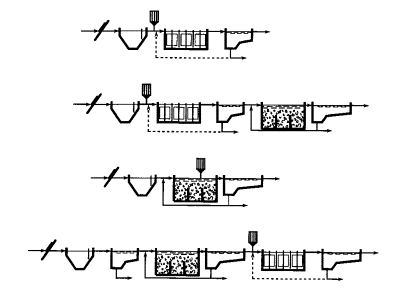
Process Types
As known, Pre-CEPT supplemented with biological treatment and simultaneous precipitation are widely used in the world, in particular, Pre-CEPT is spectacular among these processes.
4. Reaction principle and chemical dosage
When using alum and ferric chloride for chemical precipitation, the reaction metal salt Al+3 and Fe+3 salts are frequently used as precipitant. In terms of precipitation, their behaviors is almost identical, the following simplified precipitation model is frequently used:
Ferric oxide as coagulant:
Primary reaction: FeCl3 + PO4-3 →FePO4 ↓ + 3Cl-
Side reaction: 2FeCl3 + 3Ca(HCO3)2 + 2Fe(OH)3 ↓ + 3CaCl2 + 6CO2
Alum as coagulant:
Primary Reaction A12(S04)3·14H2O + 2PO4-3 → 2A1PO4 ↓ + 2SO4-3 + 14H2O
Side Reaction Al2(SO4)3·14H2O + 6HCO3 → 2Al(OH)3 ↓ + 3SO4-2 + 6CO2 + 14H2O
The chemical dosage of CEPT should comply with the requirement of phosphorus removal from wastewater. Al+3 and Fe+3 can react with PO4-3 and form insoluble precipitates ( AlPO4 or FePO4 ). Phosphorus is accomplished by removal of the formed precipitates. From a viewpoint of chemical reaction, the reaction between Me+3 and PO4-3 is that of equal mole, hence the chemical dosage is based on the quantity of phosphorus existed. However, the practical dosage of chemicals is usually greater than that of stoichiometric value because of the production of hydroxide precipitation during the reaction. We could get the impression that the hydroxide precipitation is a disadvantage. However it does have a function in connection with the flocculation as the hydroxide are precipitated as voluminous particles, and on their way through the liquid these particle can catch SS containing phosphorus.
Depending on the treatment objectives, the required chemical dosages would have to be determined from bench or pilot-scale tests. Dosage rates will vary depending on influent phosphorus concentration and desired removal. For effluent total phosphorus concentrations in the range of 0.5~1.0 mg P/L, metal salt dosage will typically vary from 1 to 2moles of metal salt added per mole of phosphorus removed. At effluent total phosphorus concentrations less than 0.5 mg P/L, metal salt dosage will be significantly higher. On a stoichiometric basis, 9.6 grams of alum are required per gram of phosphorus removed and 5.2 grams of ferric chloride are required per gram of phosphorus removed. Polymers have also been used effectively in conjunction with metal salts. Anionic polymer dosages to the wastewater will range from 0.1~0.25 mg/L (Glen T. Daigger and Thomas W. Sigmund).
Ferric Chloride Dosage:
Molecular Weight: 162.3
Assume ferric chloride solution @ 30 percent FeCl3, by weight:
Weight per liter: 1.342kg/L
FeCI3 per liter: 0.403kg/L
Theoretical Dosage = 1 mole FeCl3. per mole P = 5.235kg FeCl3 per kg P
Assume the specific wastewater requires 1.5 moles FeCl3 per mole P
Ferric chloride solution per kg phosphorus is calculated as follows:
5.235×1.5÷0.403 = 19.5 L FeCl3 solution / kg P
If WWTP influent TP concentration = 3~7 mg P/L, dosage of FeCl3 solution per m3 influent flow is:
0.003~0.007kg P/m3×19.5 L FeCl3 solution/kg P =0.06~0.14L/m3
Alum dosage:
Molecular Weight: 594.3
Assume alum solution @ 49 percent Al2(SO)3·14 H2O or 4.37 percent as aluminum.
Weight per liter: 1.33kg/L
Aluminum weight per liter: 0.058kg Al/L
Theoretical dosage = 1 mole Al per mole P or 0.5 mole alum per mole P = 0.87
Assume the specific wastewater requires 1.5 moles Al per mole P. The dosage of 49% Alum solution per kg phosphorus is calculated as follows:
0.87 ×1.5÷0.058 = 22.5 L / kg P
If WWTP influent TP concentration is 0.003~0.007 kg P/m3, dosage of Alum solution per m3 influent flow is:
0.003~0.007 kg P/m3×22.5L Alum solution / kg P = 0.07~0.16 L/m3
5. The prospect of CEPT Process for Application of Municipal Wastewater Treatment
With chemical precipitation it is possible to remove 90 percent of the suspended solids, 50 to 70% of BOD, 50~60% of COD, and 80 to 90 percent of the bacteria, and 80~90% of phosphorus.. Comparable removal values for primary sedimentation tanks without addition of chemicals are 50 to 70 percent of the suspended solids 25 to 40 percent of B0D5 and 25 to 75 percent of the bacteria.
It was reported that the use of CEPT for municipal wastewater has several advantages:
The loading and energy consumption of the downstream biological treatment might be lower, the process stability might be better, and the construction of biological facilities could be delayed. Furthermore, the bio-reactor volume, land requirement might be smaller, and higher environmental benefits of investment in short term could be achieved.
According to the operational experiences at home and abroad, the efficiency of biological P-removal is usually lower as compared with that of chemical P-precipitation. It can be estimated that phosphorus removal efficiency of A/O process ranges from 3.5% to 4.5% of BOD5 removal (sludge age 5~20d) and the phosphorus content in MLSS averages 5%. The content of particulate phosphorus in the treated effluent is dependent on SS contents in the treated effluent. Usually, it is difficult to meet the requirement of an effluent TP concentration of 1.0 mg/L (grade 2 criteria) by biological phosphorus removal process only, but the phosphorus removal efficiency of CEPT will be higher than that of biological phosphorus treatment and can meet the legal limit of 1mg/L TP in the effluent. When CEPT is supplemented with biological treatment, it is expected that the effluent phosphorus level could be reduced to 0.5mg/L (grade 1 criteria). Hence it is necessary to pay attention to CEPT for municipal wastewater. However, there still remains controversy in this regard. Several main concerns are discussed below:
1. Operational Costs
Operating cost is one of the most important problems of chemical precipitation systems. It should be evaluated in the choice of processes and monitored carefully during operation. Operating costs include chemical consumption, power, labor, maintenance, and costs of increased sludge handling. Among them, chemical consumption occupies the majority of the total costs. If waste pickle liquor is available from a reliable source, it is expected that operating costs of chemical precipitation will be decreased.
As mentioned above, If WWTP influent TP concentration = 3~7 mg P/L, dosage of FeCl3 solution per m3 influent flow is 0.06~0.14L/m3. As known, the price of commercially available ferric chloride is in the range of 1000~1500 RMB Yuan (assuming 1200 RMB Yuan in average), then the cost of chemicals added to the wastewater is approx. 0.10~0.22 RMB Yuan/ m3 wastewater. Adding the costs of increased sludge handling and others, the operating cost of CEPT based upon preliminary estimation is about 0.25~0.35 RMB Yuan/m3 wastewater. It can be seen that the operating cost of CEPT is close to and/or higher than that of biological secondary treatment (0.30 RMB Yuan/m3 wastewater). This is a considerable amount of cost that WWTP cannot bear.
2. Treatment and Disposal of Chemical Sludge
Sludge production will be increased obviously at WWTP when chemical precipitation process is used. Sludge handling was in the past and still is one of the big difficulties of this treatment process. Depending on preliminary estimates of the increase in dry solids production rates, metal salt addition to the primary sedimentation tank can result in a 50~100 percent mass increase in primary sludge and an overall increase in total sludge of 60~70 percent. Metal salt addition to the secondary clarifier will increase activated sludge mass by 35~45 percent and overall plant sludge by 10~25 percent (Glen T. Daigger and Thomas W. Sigmund). Chemical addition will cause an increase in sludge mass, volume and a reduction of sludge concentration, so the difficulty of sludge treatment and disposal will be increased. When using chemical precipitation, the additional sludge handling costs should be considered besides the cost of chemical addition.
The increase in sludge mass and volume will require larger capacity for sludge thickening, dewatering and digestion. In light of above status, the impacts of chemical addition on sludge handling have to be studied. In short, the required costs for metal addition and treatment/disposal of additional sludge production could be considerably high, so, much attention should be paid on this issue.
3. BOD5/TN Ratio of Pre-CEPT
Nitrogen is one of limiting factors for growth of algae causing eutrophication of water bodies. In particular, eutrophication of some marine waters is nitrogen limited, such as coastal waters in United States, the algae growth causing red tide is usually limited by nitrogen. In order to increase the nitrogen removal efficiency, it is necessary to use nitrification and denitrification process with internal recycle of nitrified liquor as a supplemented biological treatment. Usually, it is considered that Pre-CEPT is .in principle unsuitable for denitrification. The feed BOD value was considerably attenuated through CEPT, so, CEPT might adversely affect BOD5/N ratio and thus prejudice phosphorus and nitrogen removal. The problem raised is very similar to that of AB process.
In relation to the nitrate, if the electron acceptor needed by biomass for metabolism is only provided with nitrates , in theory, the BOD5/N ratio for obtaining good result has to be at least 2.86. Hence many experts believed that BOO5/N ratio is required to be 3 at least in the wastewater supplied to the denitrification ( anoxic ) zone .However , it is unreasonable that only the ratio value of BOD5 to total nitrogen( TN ) of raw wastewater is quoted to assess the suitability for denitrification The ratio of the BOD5 available to nitrogen needed to be removed by denitrification in influent(ΔBOD5/ΔN) is decisive for denitrification.
Assuming that nitrogen associated in the excess sludge is estimated at 5% of removed BOD5; the CEPT removal efficiency of BOD5 and TP is 40~60% and 20% respectively; the requirement of TN removal efficiency in whole process is 80%. When BOD5/TN = 4~6, the following relationship between ΔBOD5/ΔN and BOD5/TN of Pre-CEPT process can be obtained:
BOD5 removal efficiency 40%: ΔBOD5/ΔN = 0.94~0.98 BOD5/TN
BOD5 removal efficiency 50%: ΔBOD5/ΔN = 0.77~0.80 BOD5/TN
BOD5 removal efficiency 40%: ΔBOD5/ΔN = 0.61~0.63 BOD5/TN
From the above results, several main points can be seen as follows:
The variation of BOD5 removal efficiency in CEPT-stage has a considerable Influence on this relationship. To meet the requiredΔBOD5/ΔN ratio of 3 depends mainly on the BOD5 removal efficiency of CEPT-stage and the BOD5/TN ratio of raw wastewater. When BOD5 removal efficiency is 60% and BOD5/TN ratio of raw wastewater is 4, it is unable to meet theΔBOD5/ΔN ratio of 3. So, it is necessary to control the degree of BOD5 removal in CEPT-stage at a limited level in accordance with the wastewater characteristics and treatment requirement. When the BOD5/TN ratio of raw wastewater is considered to be unfavorably low for complete denitrfication, the Pre-CEPT process is unsuitable for biological nutrient removal.
6. Case Studies
Up to now, there is no successful example of chemical enhanced primary treatment systems (including Pre-CEPT) in China. However, chemical precipitation systems have been widely used in some developed countries. Metal salt addition to primary and/or secondary treatment systems has been practiced to meet a 1 mg P/L monthly average phosphorus standard.
Because of widespread usage of chemical precipitation system in some regions of the world, a lot of information is already available in the literature. Two cases from United States (Glen T. Daigger and Thomas W. Sigmund) are described briefly for reference in the following:
1. Junes Island WWTP, Milwaukee, Wisconsin
The Junes Island Wastewater Treatment Plant is a 1136000 m3/d peak flow secondary treatment plant with metal salts addition for phosphorus removal. Influent wastewater receives preliminary treatment before it is split between two parallel plug flow activated sludge plants. The East Plant receives approximately 60 percent of the total flow, while the West Plant receives the remaining 40 percent. Waste pickle liquor, a ferrous sulfate solution, is added to the East Plant influent and the iron is oxidized from the ferrous to ferric state in the aeration tanks. Waste activated sludge from the East Plant is transferred to the West Plant; excess iron in the waste sludge serves as an iron source for phosphorus removal in the West Plant. Vacuum filter filtrate, which contains a sizable quantity of residual iron from ferric chloride conditioning of the sludge, is also returned to the West Plant.
The treated effluent of Junes Island WWTP is discharged to Lake Michigan. Its monthly average discharge standards are 30 mg BOD5/L, 30 mg SS/L and 1 mg TP/L.
Waste sludge from the West Plant is gravity thickened and then dewatered by vacuum filters. The dewatered sludge is dried and then packaged and marketed as a soil conditioner/fertilizer.
Average wastewater characteristics of Junes Island WWTP for 1985-1986 are:
Influent flow: 522300 m3/d;
Influent: BOD5 260mg/L; SS 210mg/L; TP 5 mg/L.
A 0.5 percent phosphorus limit in laundry detergents was in effect in Wisconsin.
Since 1979, the plant has been almost continuously in compliance with its monthly average discharge standards.
Junes Island is a successful example of metal salt addition to an activated sludge plant for phosphorus removal. Waste pickle liquor is delivered free of charge and is used to achieve effective phosphorus reduction through the facility. The addition of pickle liquor results in additional quantities of sludge to be disposed. However, sufficient capacity for sludge handling is available in this plant and reliable performance is achieved by the system.
2. South Shore WWTP. Milwaukee. Wisconsin
The South Shore WWTP is a 757000 m3/d peak flow secondary treatment plant with metal salt addition for phosphorus removal. Influent wastewater receives preliminary treatment prior to primary sedimentation and biological treatment in a plug flow activated sludge system. The treated effluent is discharged to Lake Michigan.
Waste pickle liquor is added to the primary sedimentation influent for phosphorus removal. Waste pickle liquor as received at the plant contains iron primarily in the ferrous (+2) state. Prior to its addition to the primary influent, chlorine is used to oxidize the pickle liquor. This converts the ferrous (+2) iron. to ferric (+3) iron.
Waste activated sludge is thickened and then anaerobically digested with the primary sludge. Digested sludge is lagooned prior to agricultural use.
Lagoon supernatant is returned to the inlet of the plant. The monthly effluent limits for South Shore are identical to those for Jones Island. The average influent flow and characteristics for 1985~1986 are:
Influent Flow: 378500m3/d;
Influent: BOD5 138 mg/L; SS 169 mg/L; TP 5 mg/L.
This plant is also affected by the ban on phosphorus in laundry detergents.
Addition to the primary clarifiers offered two advantages:
(l) An increase in the quantity of more easily handled primary sludge and a decrease in the quantity of more arduously handled waste activated sludge;
(2) System performance was improved due to the reduction of phosphorus content of activated sludge mixed liquor.
No impact of iron addition on anaerobic digester gas production or on the quality of the lagoon supernatant was noted. Iron dosage averaged approximately 1 mg/L as iron per mg P/L in the influent wastewater. At these dosages the effluent total phosphorus concentration was reliably below the monthly average discharge limit of 1 mgP/L.
7. Summary
As mentioned above, the use of CEPT for municipal wastewater treatment has a lot of advantages in the respect of removal efficiency, performance stability, capital costs, operational stability, and environmental benefits of investment. The disadvantage of applying this technique is the higher operating costs and difficulties of sludge treatment/disposal. Therefore, uncertainties exist with respect to applicability and prospects of applying this technique. At present, the application and dissemination of CEPT in China will be difficult with the exception of the regions where waste pickle liquor is reliably available. Hence, in addition to strictly control of pollution source, it is necessary to strengthen the process research and remove the obstacles for applying this technique. In order to create a favorable condition for practical application of this process, the main task is to prepare chemicals with high efficiency and low cost for reducing the expense of chemical consumption and sludge quantity. In addition, the overall comparison among CEPT, simultaneous precipitation, and other biological nutrient removal processes should be made by contrast experiment and engineering analysis. Thus, the finally reliable results could be achieved.
References
1. Ingemar Karlsson ( kemira Kemwater, Stockholm, Sweden ), "Chemical Sewage Treatment in Combination with and without Biological Treatment", Proceeding of International Conference on Water and Wastewater, Beijing, China, July 12~16, 1994.
2. Glen T. Dagger and Thomas W. Sigmund, "Design and Operation of Chemical Phosphorus Removal Facilities", Phosphorus and Nitrogen Removal From Municipal Wastewater- Principles and Practice, Second Edition, 1991.
3. Zheng Xingcan and Li Yaxing, "Technology of Phosphorus and Nitrogen Removal from Wastewater", First Edition, Nov. 1998.
4. Mogens Henze, et al, "Wastewater Treatment - Biological and Chemical Process" Second Edition, 1996.
5. "Proceedings of Water Industry and its Subject System." 1998 Beijing, China.
6. ."Proceedings of International Conference on Water and Wastewater." July 11-15, 1989 Beijing, China.
7. "Proceedings of Water and Wastewater Industry and Sustainable Development", Tsinghua University Press, September 1998.
8. "Proceedings of 4th CIWEM/JSWA Technology Exchange Workshop on New Process Technology/Systems in Wastewater Treatment Management." November 6-7, 1995, Tepia Hall, Tokyo, Japan.
9. "Study on Subject System Construction for Water Industry." China Water & Wastewater Society, January 1999.
10."Water Environment Purification and Microbiology of Wastewater Treatment", China Architectural Engineering Press, 1988.
論文搜索
月熱點論文
論文投稿
很多時候您的文章總是無緣變成鉛字。研究做到關鍵時,試驗有了起色時,是不是想和同行探討一下,工作中有了心得,您是不是很想與人分享,那么不要只是默默工作了,寫下來吧!投稿時,請以附件形式發至 paper@h2o-china.com ,請注明論文投稿。一旦采用,我們會為您增加100枚金幣。