

Water Sector Strategic Planning:Overview, Concepts and Princ
| 論文類型 | 基礎研究 | 發表日期 | 1999-09-01 |
| 來源 | 21th Century Urban Water Management in China | ||
| 作者 | Ronald,North,Dajun,S | ||
| 摘要 | Water Sector Strategic Planning: Overview, Concepts and Principles Ronald North (University of Georgia, 165 Rocky Branch Road, Athens, GA 30605-4510) Dajun Shen (Department of Water Resource | ||
Water Sector Strategic Planning:
Overview, Concepts and Principles
Ronald North
(University of Georgia, 165 Rocky Branch Road, Athens, GA 30605-4510)
Dajun Shen
(Department of Water Resources,
China Institute of Water Resources and Hydropower Research, Beijing 100044, China)
Abstract: This paper discussed about the water sector strategic planning which begins to apply to the water sector all over the world. The paper analyzed its backgrounds, overviewed the strategic planning in the water sector, and developed its concepts and principles, and formed the frameworks, which are flexible for user to learn and apply.
1. Introduction
A major management initiative requires "out of the box" thinking and careful analysis to achieve good results. The more entrenched and historically successful the existing management institutions, that served their customers and sponsors well for the time and conditions, the more difficult and costly to effect change to new conditions. This is nearly universal in the water sector that has operated historically on the basis of providing structural solutions to increase useable supply as the main tool to manage water under conditions of relative abundance. But, in China, and much of the world today, the conditions are those of relative scarcity and competing demands such that one use voids or restricts another use or opportunity that might be of higher value to the Nation, the river basin or the community. Thus, we have developed many more tools for management -- some are economic or financial, some are legal or regulatory, some are functions of better scientific and economic information, some are educational or institutional and some are new techniques of managing to achieve specific results or goals and objectives.
In the water sector, there is a single migratory resource, variable in time and space and required in variable qualities and quantities for multiple users who have substantial historical use habits. There is no more complicated management requirement known than that for the water resource. Thus, we must develop a clear set of priorities, goals, objectives, costs, benefits, databases, analytical tools and measurement criteria for the resource and its contributions to the economy on society. Then we choose the best available management tool (most likely a combination of several tools) to optimize the value of the resource. These tools do not need to be only quantified models but must include all of those means available to achieve best results. How will we know when results are best? This requires constant evaluation and analysis on a systematic basis and the inclusion of all closely relevant stakeholder interests. It also requires a substantial effort and commitment on the part of responsible officials and managers and a significant allocation of manpower and money resources. That is what we called "Water Sector Strategic Planning".
2. Overview for Water Sector Strategic Planning
The development of a strategic planning process or framework that will provide a basis for defining, quantifying, evaluating, recommending and eventually choosing and implementing certain options or sets of options to improve the effectiveness of water management. Measuring the effectiveness of "management" is a key issue to be addressed. There are many measures of management results and no single measure has been found to be the perfect one. In practical terms, management results are measured in many terms -- some quantified and some described more in terms of general preferences. Historically, the effectiveness of water resources management has been judged on the basis of general satisfaction with the allocations of water and the level of services provided. This method of measuring success has worked well in a world of generally sufficient water supplies. As water supplies per capita decrease and as per capita consumption for all people increases it becomes more necessary to measure the effective use of the resource more carefully and with some idea of assigning priorities to the highest valued uses for both consumption and development. This means paying attention to the values added by each decision and by each activity undertaken.
Thus, the measurement of management success in the water sector becomes more critical in terms of economic and financial measures and includes other measures of social well being such as food supply, health and safety, environmental quality, conservation, disaster prevention, etc. In the water sector, it is needed to bridge the transition from a less formal management system with historical success to a more formal system of setting priorities, goals and objective, while recognizing constraints and new opportunities. This means developing institutions, policies and systems at all levels to implement the strategic planning process, while making adjustments for changes in priorities and needs over time and geography. This need for flexibility within a formal management structure creates the need for a "Strategic Planning Process" with options considered, rather than a fixed plan for development or management of water for a basin, a region or a nation. A strategic plan is much more than a traditional master plan in terms of scale and level of application. A traditional master plan deals with the design details of specific projects while the strategic plan develops the overall national or basin goals and objectives, priorities, to include institutions, management systems, data bases, funding and repayment mechanisms and the principles and standards for the sector. Strategic planning often has been claimed for the water sector but seldom achieved.
In the development and evaluation of a practical strategic planning process, for each issue considered there may be several physical, management and/or institutional options or sets of integrated options developed, consistent with the water sector strategic planning. Some issues and constraints will persist at all levels from the State down to the village. Other issues and constraints may exist only for specific levels, for example at the basin or provincial level. By implication those should be a part of a strategic planning and management process at that level. Specific issues may include problems such as imbalance of supply and demand, pollution, inefficient use of water, legal or management conflicts among users, disaster management (salinity, drought and flood hazards), funding, pricing, etc. The strategic options will address some of these issues (physical and management) as an application of the water sector strategic planning process. The selected options may encompass development of opportunities related to local or national economic development of the water sector such as hydropower production, irrigation and drainage, water conservation, water supply and urban flood control projects (Figure 1).
In general, strategic planning options could be divided into two broad types: physical or structural and managerial or program options. Physical options include structural solutions to meet physical development needs of the water sector. Physical options need to be associated with some managerial options and measures for effective implementation. The managerial options may include institutional measures and human resources management or financial programs for improving net benefits and sustainable management of the water sector. Some specific management options might include strengthening of water user‘s associations and enterprises, strengthening institutions and management skills, strengthening the legal framework for allocation and reallocation of the water resources at basin, provincial and central levels, introduction of demand management measures (pricing, conservation technologies), water reuse, educational measures (motivation and incentives), watershed management practices, economic policy changes to increase effectiveness and efficiency of water sector investments, development of management information systems and introduction of budgeting and financial management programs.
Options for the strategic planning process are being developed in continuous collaboration and consultation with officials in the different ministries and agencies at local, basin, provincial and central levels. For each critical issue, a matrix for first identification of options might be developed to facilitate stakeholder participation in developing, understanding and evaluating the available options. Each option will be evaluated using criteria that include national policy objectives, effectiveness and efficiency measures, sustainability estimates, political and public acceptability as well as environmental, social, economic and financial considerations.
3. Strategic Planning in the Water Sector
Planning in the water sector is a formal process of designing projects for nations, river basins, provinces cities etc., that may or may not establish or achieve any larger goals or objectives in terms of net economic growth, values added, environmental enhancement or social wellbeing. A traditional master plan from this process is a written document describing primarily physical attributes of a project. A superficial economic analysis and environmental assessment (impact statement) may be added to meet legal, funding or environmental regulations.
A strategy (or strategic plan) for the water sector is a focused course of action an organization is following to insure its success and/or survival for a currently relevant environment (culture, internal systems, institutions, people and other resources). For example, a strategic plan for the water sector in China must also recognize that profound changes are taking place in the government and in the economic environment (culture, governance, internal systems, institutions etc.). This means that any strategic plan must be a process with frequent attention to the changing environment while maintaining a high level of stability and quality in services provided. Thus, the water sector strategic planning is appropriate for the situation in time, values, culture, internal systems, resources and mission.
Strategic planning for the water sector (including subsectors and functions) is the process of creating an organizational focus on specific goals, objectives, options and targets (success indicators) that are in tune with the strategic mission; that are measured, evaluated and revised regularly.
Now some threats to developing and implementing a good strategic planning in the water sector in government (and other) organizations:
- There will be substantial resistance to change;
- The " good old days" mentality will be pervasive ( "This is not the way we have always done this job");
- Citizens, users, partners, politicians and co-workers will not recognize the value of existing resources or services that might be managed differently for a more effective outcome;
- A lack of commitment (professional and/or emotional) of the leadership, workers and the whole organization (sector) to a simple success indicator…we must provide the best possible services to our users and stakeholders;
- A good strategic planning may have a weak execution strategy (how do we do this?);
- Improper incentives to match the mission statement, goals, objectives and target levels. For example, if a goal/objective is to improve water quality in all rivers to meet existing standards, and there is no funding for monitoring and enforcement, then the incentive to achieve this goal/objective is inadequate;
- Confusing forecasting (extending current trends) with planning (for new trends);
- Doing well what should not be done at all;
- Fighting dragons. The failure to recognize, acknowledge, and address issues or problems with the strategic plan or its implementation.
4. Concepts and Principles of Water Sector Strategic Planning
The basic concept of a strategic planning process is to develop a mission statement of goals, then conduct a S.W.O.T. analysis and recognize all constraints. The S.W.O.T. is an integral, straightforward analysis of the organizations‘ strengths, weaknesses, opportunities and threats. From this step 2, one can then move forward to develop objectives, targets for evaluation and implementation.
A broadly defined, enduring (but changeable) statement of the organization or water sector purpose that identifies the "Raison de etre" (reason for being) and the broad scope of its services to stakeholders is a MISSION STATEMENT. Missions of organizations and agencies change over time with changes in internal and external conditions. Mission statements should be simple, understandable, sincere, and provide:
- A clear guide to priorities, decisions and actions;
- A unique identity to sector, sub-sector, functional organization;
- A definition of values and ethics of the organization;
- A focus on the water sector at all levels;
- recognition of the era, technology, lifestyles of the sector on all levels, and
- added value to the stakeholders.
A strategic plan for the water sector is complex and must be given special attention. The water resource is a migratory (flowing) resource that provides a wide range of services from direct consumption by all living things to the need to provide aesthetic and natural values. This single resource provides a multiple range of services to man and nature. Thus, its "value" to society is much more than for most other resources and these "incommensurate values" are measured in different ways. Some uses of water must forever remain free but other uses must be provided and paid for (Figure 2). The water sector has a long history as a "common good" available to all for the taking. As the total available water resource remains static and demands grow there are more and more conflicts over its use. In our time the rescue must be managed and allocated carefully since not all needs can be met for free.
A major issue in managing the water resource as a scarce resource rather than as a free resource is that of how to recognize its value in non-financial uses and measure those values in non-commensurate terms while simultaneously allocating part of the resource to a domestic, commercial, or industrial use for which benefits, rewards and profits are produced and additional costs are incurred. It is well known that for any scarce resource or product a pricing (valuation) system is the best of all methods at allocating the resource among competing users. Thus, the Figure 2 provides an overview of the complexity of the water sector in terms of the non-market and market (economic and financial) treatment of the scarce resource.
There are many options for handling the non-market sector. Some include reservations for non-market uses, quotas, set-a-sides, permit restrictions, watershed protection, loans and other policy based management options. At some point of increasing scarcity, it is necessary to estimate the relative and marginal values of using water for various needs in order to know the highest values that might be realized from the resource for both market and non-market need. This condition leads to the development and use of multiple-objective models and methods of allocating the water both efficiently and equitably for the optimum total satisfaction level.
A standard strategic planning process is outlined in Figure 3. This schematic provides a specific path from the mission statement and goals to the objectives, physical resources analysis (important to the water sector traditionally), identification of issues, constraints and opportunities or options (S.W.O.T.). This process then leads one to develop strategic options and recommend a feasible set of options to meet some set of specified goals and targets. The strategic planning process must then develop an implementation program and assess (evaluate) the options according to specified and measurable "success indicators."
The multiple purpose uses of water pre-determine that a water sector strategic planning process include sets of goals, objectives, options to insure on effective allocation and maximum net value for the total resource within a planning time, space, and environment. The basic economic model is normally presented in terms of several resources providing a valuable product and we optimize our consumption by balancing all products within our budget (constraint). In the water sector, the norm is one shared resource to be optimized among many resource inputs and among many end users. Thus every organization or user must have input into the statements of goals, objectives, options, policies, decisions and operations. This makes the list of stakeholders for water resources and services very large indeed. A successful strategic plan must include all of the relevant interests. At this point we face a dilemma in balancing the long term aspects of a strategic plan with the short- term aspects of meeting constantly changing and unpredictable demands with equally stochastic changes in water supplies. Thus, flexibility must be a major component of any strategic plan if we are to mange well in the short-term environment of the dominant non-water world.
A practical outline of a water sector strategic plan is shown in Figure 4. This is a multiple level management structure for the water sector to include multiple agency and multiple area configurations so necessary to deal with the water sector (top half of Figure 4). This structure also includes suggestions for a coordination mechanism (Council, Leading Group, Commission, etc.) so useful at the level of the leading management agency to maintain a focus on the whole water sector. Each strategy is an independent function of each unit with its own goals, objectives, options, evaluations, etc.
A water sector strategic planning process must also deal with the very important external "functional" strategies to meet service needs of irrigation, flood and disaster management, hydropower, M&I water supply, environmental water quality, transportation, etc. (lower half of Figure 4). In addition there are the inevitable internal functional strategies for each agency, commission or other unit. These include operations, human resources, financing, training, costing and pricing, service quality, information technology system and of course regular planning requirements.
The remaining level of activity is the operational or implementation strategy. This is the most important and the most frequently ignored step in strategic planning. One sees hundreds of strategic plans and very few include a serious or enforceable implementation strategy. Without this step the enormous effort to develop a strategic plan goes unrewarded.
The best we can do is to start the strategic planning process with a clearly defined set of goals to be measured by specific success indicators or targets. These targets (also known as goal levels in models) are measured by specific and well-defined criteria that may be quantified or descriptive. The objectives are a macro-level national, basin, provincial or city set of priorities for the sector, such as economic efficiency (GDP), cost recovery, income redistribution, environmental quality, social well-being, etc. The typical goals in developing countries or water resources include balancing supply and demand, net additions to GNP (economic efficiency), equitable distribution of water (as well as benefits and costs), environmental quality enhancement, food self-sufficiency, energy system enhancement (power), disaster prevention and management (flood control), social well-being, etc. The specific objectives for each goal may be more or less detailed. For example the balance of supply and demand might include both the construction of X CuM of reservoir capacity or diversions and/or conserving Y CuM of reduced withdrawals from water savings or pricing policies. The basic process of strategic planning is shown in Figure 5, with goals and objectives at the center of the system. Without this definition and focus we have less chance of effective management because we are more apt to wander around in the water sector without focused policy making and implementation. Also, we might never develop the criteria for accountability and measuring progress or lack of progress. Thus, it becomes near impossible to link budgets, expenditures, revenues, benefits and costs to the goals and objectives. A good strategic plan (revised regularly) is the best possible management tool.
Also, in Figure 5, we can see that the water sector goals and objectives and options are linked to national and/or subarea/subsector in order to maintain consistent national policy directions or to adjust to changes in national priorities. The unique aspect of strategic planning for the water sector is the recognition of the physical and structural (traditional) options for water sector management while including the newly relevant "management options" such as pricing, regulation, financial and educational options. In this approach to the water sector strategic planning one can also intervene easily with advanced techniques of optimization and integration of functions for achieving constantly improving results and some higher level of sustainability for the water sector as an important contributor to national and local well being.
The physical/structural options box (Figure 5) of strategic management tools must include the projects and programs that provide the physical management of the water resource for increased supplies and for storage to meet temporal variations and for diversions to alleviate spatial anomalies. Likewise, the economic management box must include the economic, financial, environmental, organizational and related tools to provide the balance of "Total Management" required for efficient, equitable and effective development and utilization of the water resource. This action makes water an important resource for increasing national economic benefits and, if done well, enhancing natural and environmental benefits.
Further elaboration on the management system options box is shown in Figure 6, 7, and 8. The "pricing and financing management option" (Figure 6) will become a central part of the water sector strategic planning. This is a pervasive, high priority option that exists in every functional and operational level of the water sector (Figure 4). It results from the economic reform initiative and is a natural focus for strengthening the resources management authority and the sustainability of all aspects of the water sector. It can easily be developed into a viable, practical, national strategy. This process detail shows the extent to which a simple option such as pricing changes must be fully developed and applied for all users, to met relevant objectives and cost structures and thus provide the financial, economic and efficiency results expected from the strategic plan.
The educational and training box and the institutional and social box of the management tools have been detailed in Figure 7 and 8. Those tool boxes of options offer some general applications for a water sector strategic planning.
Thus, all of these form a water sector strategic planning. The functions performed in the water sector strategic planning include all aspects of needs such as flood control, hydropower, irrigation, as well as environment etc. and the management tools (pricing, education, institutions etc.) to achieve economic efficiency and equality. It will help to define both traditional standard and business management options to provide measurable performance standards and to lead to the objective optimization of the valuable and scarce water resources, and to maximize the economic value added to economy by managing the water resources effectively to achieve specified goals and objective. It is practical and useful to all levels of water administration and management.
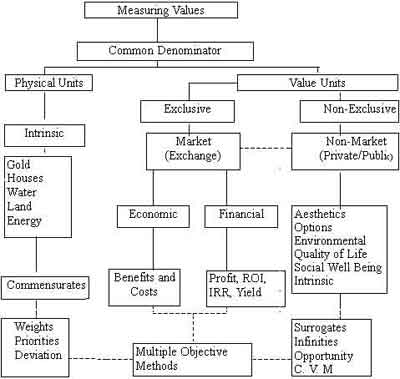
Figure 2, Illustration of Relationships and Measurement Techniques For Incommensurate Values In The Water Sector Strategic Planning With Multiple Objectives.
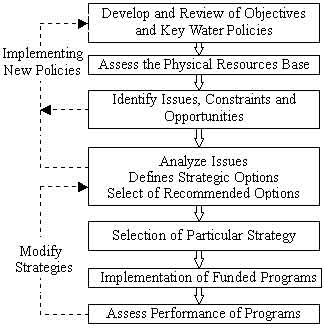
Figure 3, Strategic Planning Process
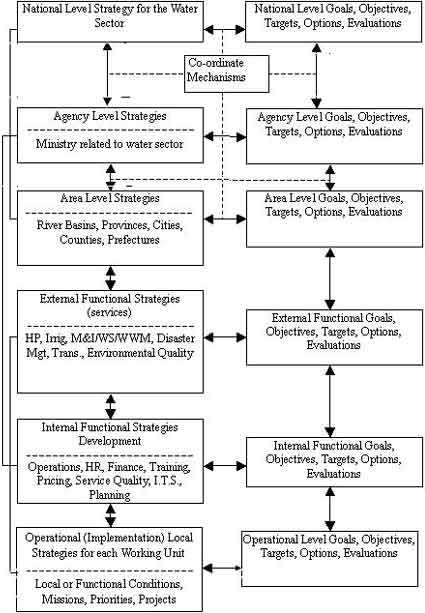
Figure 4, Multiple Level Management and Coordination of Strategies, Goals, Objectives, Targets and Evaluations for the Water Sector.
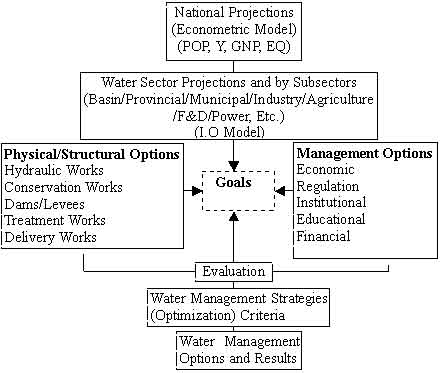
Figure 5, A Simplified Model of A Water Sector Strategic Planning Process: Focused on Goals/Objectives with Structural and Management Alternatives Identified. Management and Structural Options Must Be Integrated for Best Results.
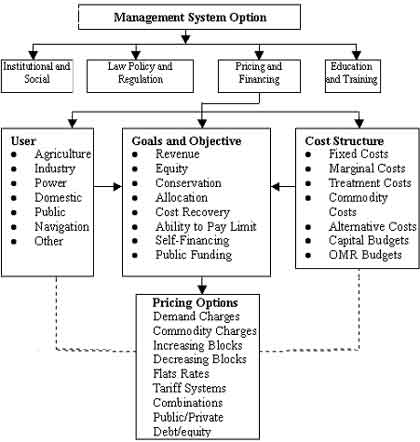
Figure 6, Illustration of Strategic Planning and Management Options for Water Services: Pricing and Financing.
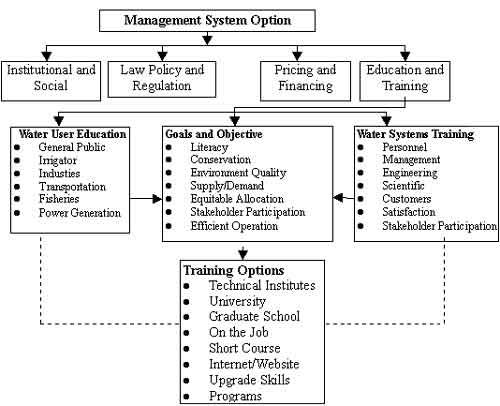
Figure 7, Illustration of Strategic Planning and Management Options for Water Services Education and Training
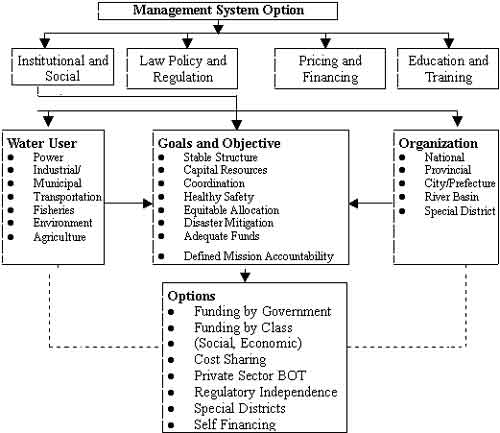
Figure 8, Illustration of Strategic Planning Management Options for Water Services: Institutional and Social.
論文搜索
月熱點論文
論文投稿
很多時候您的文章總是無緣變成鉛字。研究做到關鍵時,試驗有了起色時,是不是想和同行探討一下,工作中有了心得,您是不是很想與人分享,那么不要只是默默工作了,寫下來吧!投稿時,請以附件形式發至 paper@h2o-china.com ,請注明論文投稿。一旦采用,我們會為您增加100枚金幣。